Continuous Line French Press
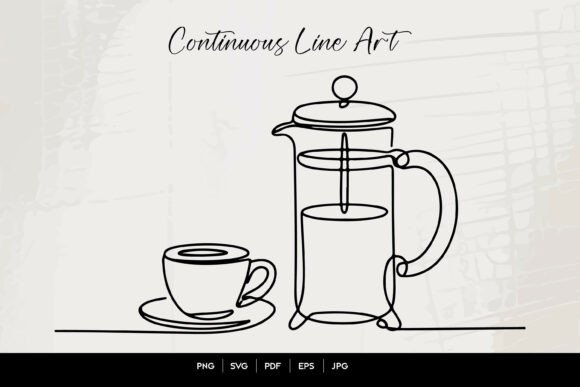
As someone who’s stitched hundreds of designs across apparel, home goods, and boutique merchandise, I opened the Continuous Line French Press file set expecting simplicity—and found something more valuable: quiet confidence. This isn’t a flashy, over-rendered coffee icon. It’s a single, unbroken line tracing the silhouette of a French press—handle, carafe, base, and lid—all in one graceful loop. No fills, no gradients, no extra flourishes. Just clean, intentional line work. That restraint is its strength—and its first real test.
Mood & Fit: Minimalism with Warmth
The Continuous Line French Press lands somewhere between modern craft and cozy ritual. It doesn’t shout “barista” or “espresso bar”—it whispers “morning light, steam rising, quiet focus.” That makes it ideal for products where subtlety builds connection: embroidered kitchen towels for a small-batch ceramics shop, linen aprons for a local roastery, or baby onesies where delicate line work reads as tender, not trendy. I recently mocked it up on a natural canvas tote bag—no fill, just black thread on off-white fabric—and it looked handmade in the best way: considered, calm, and unmistakably caffeinated.
Real Embroidery Behavior: Where It Shines (and Where to Pause)
In practice, this design performs beautifully on stable, medium-weight fabrics: cotton twill for aprons, brushed poly-cotton for sweatshirts, terry cloth for tea towels. As a machine embroidery design, its low stitch count (inherent to continuous-line style) means minimal thread build-up, less stabilizer fuss, and excellent drape—even on curved surfaces like baseball caps or pillow covers. I ran it on a lightweight knit baby onesie using tear-away + light cut-away stabilizer, and the line stayed crisp without puckering.
That said, it’s not universally forgiving. On highly textured fabrics—like heavy waffle-weave towels or bouclé blankets—the fine line can visually dissolve unless you increase stitch width slightly or use a contrasting thread (e.g., cream on charcoal). On dark fabrics, avoid pale pastel threads; go for charcoal grey or deep espresso instead. And while it scales well down to ~2.5" wide, anything smaller than 2" starts losing definition in the lid curve and handle joint—so skip it for tiny cap brims or baby hat fronts unless you’re willing to simplify manually.
Commercial Use & Customer Perception
For Etsy sellers and craft business owners, the Continuous Line French Press works because it feels intentional—not clip-art. Customers browsing handmade goods respond to authenticity, and this design delivers it. When used on a custom embroidered patch for a café’s staff aprons, it read as part of a cohesive brand—not an afterthought. On personalized gifts (think: “Brewed with Love” + this icon on a holiday mug towel), it adds warmth without clutter. It also translates cleanly into printable mockups for digital product previews, especially when paired with neutral backgrounds and soft shadows.
What it doesn’t do is dominate. That’s a feature, not a flaw—if your goal is bold statement embroidery, look elsewhere. But if you’re building a collection of refined, repeatable design assets for a lifestyle brand, this is exactly the kind of versatile, non-trendy icon that holds value season after season.
Practical Designer Notes Before You Stitch
- Test first: Run it on scrap fabric matching your final product’s weight and stretch—especially for knits or textured weaves.
- Check contrast: View your chosen thread color against both light and dark fabric swatches before digitizing or stitching.
- Review stitch density: Though inherently low-density, confirm no unintended overlaps or tiny loops in the vector files (SVG/EPS) before converting to embroidery format.
- Hoop size matters: At standard 3.5–4" width, it fits comfortably in most 4x4 hoops—but measure your hoop’s usable area, not just the frame.
- Stabilizer strategy: Use medium-weight cut-away for knits, tear-away for stable wovens, and add a light topping for napped fabrics like terry.
- Licensing check: Since this is a Graphics file set sold for Crafts, verify whether commercial use (e.g., selling finished embroidered totes) is permitted—don’t assume.
- Mockup wisely: Try black-and-white versions first. If it reads clearly without color, you’ve got a winner for monochrome branding or minimalist packaging.
Beyond the Hoop: Design Longevity
What makes the Continuous Line French Press stand out isn’t novelty—it’s timelessness. Unlike illustrative coffee icons packed with steam swirls or typographic slogans, this design avoids visual noise. That means it won’t feel dated next year, and it pairs effortlessly with other hand-drawn line art in your collection. For small shop owners curating cohesive seasonal lines—think “Morning Ritual” kitchen bundles or “Slow Brew” nursery decor—it functions as a subtle anchor, not a standalone star.
I’ve already added it to my go-to folder for custom embroidered pillow covers (linen + oatmeal thread), wholesale apron orders (cotton drill + navy), and limited-run holiday tea towel sets (organic cotton + charcoal grey). Each time, it reinforced the same truth: the most effective embroidery designs don’t compete for attention—they earn it through clarity, consistency, and quiet craftsmanship.
Final Thought: A Design That Respects the Craft
The Continuous Line French Press isn’t just another coffee graphic. It’s a reminder that thoughtful editing—removing everything non-essential—creates space for meaning. For embroidery designers, small business owners, and makers who value integrity over instant impact, it’s a rare find: simple enough to stitch reliably, expressive enough to resonate, and refined enough to represent your work well—whether you’re embroidering a single gift or launching a full product line.