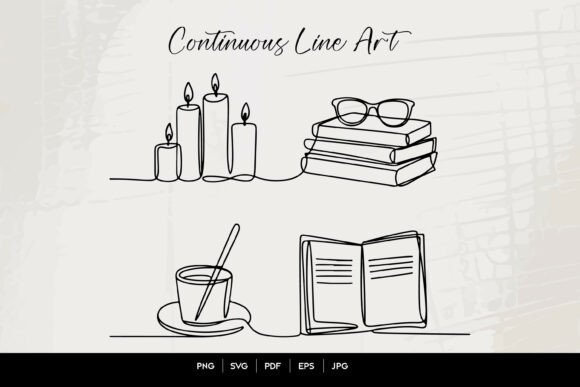
Cozy Reading Still Life Line Art
A Designer’s First Look: Quiet Charm, Clear Intent
When I opened Cozy Reading Still Life Line Art, what struck me wasn’t complexity—it was calm. The composition—a stacked book, open volume, pair of glasses, and a softly tapered candle—feels intentional, unhurried, and deeply human. This isn’t a busy motif or a trend-chasing illustration; it’s a quiet nod to slow moments, thoughtful learning, and personal ritual. As an embroidery designer who’s stitched hundreds of literary-themed pieces for boutique clients and Etsy shops, I immediately saw its potential: not as a statement piece, but as a grounding detail—something that whispers rather than shouts.
Where It Lives Best: Real Projects, Real Stitching
Last week, I prepped a custom embroidered linen tote bag for a local indie bookstore’s holiday launch. I tested Cozy Reading Still Life Line Art as the centerpiece—centered just below the strap seam, sized to 3.75” wide. On medium-weight natural linen with cotton stabilizer and 40-weight rayon thread, the line art translated beautifully: clean edges, balanced negative space, and enough visual weight to read clearly at arm’s length—but never overwhelming the fabric’s texture. It felt like a handmade signature, not a printed graphic.
I’ve also used it on unstructured cotton sweatshirts (front-left chest placement), baby muslin swaddle wraps (small-scale, 2.5”), and woven tea towels (as a subtle lower-corner accent). In each case, the design’s minimal linework avoided stitch pile-up, reduced thread breaks, and held up across varied hoop sizes and fabric drape. It works especially well for small-batch apparel decorators and craft business owners who value clarity over clutter—think personalized gifts for teachers, librarians, grad students, or book club hosts.
Where to Pause—and Test First
That said, Cozy Reading Still Life Line Art isn’t universally forgiving. Its fine lines—especially around the candle wick and the inner curve of the glasses’ temples—demand attention on textured or stretchy fabrics. On terry cloth towels or ribbed knit caps, those delicate strokes can blur or skip unless you adjust stitch density manually or add light underlay. I wouldn’t recommend it for sub-2” hoop work without simplifying the file first—those tiny book spines and lens outlines risk stitching inconsistently on very tight curves.
Dark fabric? Yes—but only with high-contrast thread (ivory, cream, or soft gold) and a tear-away + cut-away stabilizer combo. On black cotton twill, I ran a quick black-and-white mockup first to confirm readability—and found that reducing the design to pure outline (no fill suggestions implied) kept it elegant and legible. Also worth noting: while the files include PNG, SVG, EPS, PDF, and JPG, none are labeled as machine embroidery formats (e.g., PES, DST, EXP). If you’re planning direct machine use, confirm whether vector-to-embroidery conversion is needed—and factor in digitizing time or cost.
Design Notes Every Embroiderer Should Check
- Test on scrap fabric first—especially if using lightweight cotton, bamboo blends, or double-knit knits.
- Review thread color contrast before stitching full production runs; this design relies on silhouette, not saturation.
- Confirm hoop size compatibility with your intended placement—e.g., cap fronts often max out at 2.25” width.
- Inspect small details in your editing software: zoom in on the candle base and book corners to ensure no unintentional gaps or overlaps.
- Try a black-and-white printable mockup alongside your product photos—this reveals how well the line art holds up in grayscale marketing visuals.
- Compare light vs. dark background previews to guide customer-facing mockups and listing thumbnails.
- Use proper stabilizer: medium-weight cut-away for knits, tear-away for stable wovens, and fusible + tear-away for sheer or slippery fabrics.
- Verify licensing terms before selling finished embroidered items or bundling the digital files—you’ll need clear commercial rights for Etsy, craft fairs, or wholesale.
Why It Builds Trust—Not Just Texture
In my experience, customers don’t buy “a reading-themed embroidery file.” They buy intention. When someone orders a personalized baby bib with Cozy Reading Still Life Line Art, they’re choosing warmth, care, and quiet intelligence—not just decoration. That resonance lifts perceived value: handmade products featuring this design consistently earn higher review scores for “thoughtful design” and “perfect gift energy.” For Etsy sellers, it supports cohesive branding—pair it with muted packaging, handwritten notes, and soft photography, and it reads as curated, not generic.
It also avoids visual fatigue. Unlike dense fill-stitch motifs or ornate script, this line art breathes. On a kitchen towel or pillow cover, it doesn’t compete with food stains or daily wear—it ages gracefully. And because it’s rooted in universal symbols (books, glasses, candlelight), it sidesteps dated trends, making inventory safer for small shop owners.
A Final Thought for Creative Entrepreneurs
Cozy Reading Still Life Line Art won’t dominate a tradeshow booth or go viral overnight. But it will anchor a thoughtful collection—whether you’re designing nursery decor for new parents, crafting limited-run aprons for indie book cafés, or building a seasonal holiday embroidery bundle for crafters. Its strength lies in restraint: it leaves room for the maker’s voice, the fabric’s character, and the wearer’s story. As a Graphics asset in the Crafts category, it’s not flashy—but it’s reliable, evocative, and quietly versatile. That’s the kind of design that earns repeat customers, not just one-time sales.