Winter Christmas Village Silhouette
A Designer’s First Look: Quiet Charm, Clear Intent
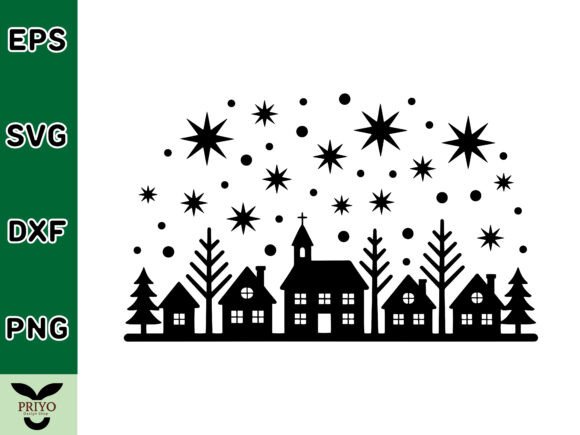
When Winter Christmas Village Silhouette landed in my inbox, I paused—not because it shouted, but because it breathed. This isn’t a busy holiday mashup; it’s a composed, snow-dusted vignette of clustered houses under a starlit sky. The silhouette treatment gives it instant cohesion and scalability, and the gentle curve of the rooflines suggests warmth without clutter. As an embroidery designer who’s stitched hundreds of seasonal pieces, I immediately saw its natural home: not on a neon sweatshirt for teens, but on a cream linen tea towel, a charcoal baby blanket, or a structured cotton tote bag meant to last beyond December.
How It Stitches—Not Just How It Looks
I tested Winter Christmas Village Silhouette as part of a small-batch holiday collection: embroidered kitchen towels for a local boutique. On medium-weight linen with tear-away stabilizer, the design held crisp edges and balanced stitch density—no puckering, no thread nesting in the star points. The houses’ outlines responded well to satin stitch, while the open negative space between them allowed fill stitches to breathe. That’s critical: many “cute” village designs drown in dense fills, but this one respects fabric real estate.
For custom apparel like sweatshirt embroidery or tote bag design, the silhouette’s clean profile means it reads clearly even at 3.5–4 inches wide—the sweet spot for chest placement. On baby embroidery? Yes—but only on stable, non-stretchy weaves (think interlock cotton, not jersey). The stars are delicate, not microscopic, so they translate reliably down to ~2.75 inches with proper stabilizer and reduced top tension.
Where It Shines—and Where to Pause
- Strong fits: Embroidered patch backings, pillow covers with tight-weave canvas, aprons with minimal seam interference, nursery decor on cotton duck, and holiday gift tags made from felted wool.
- Careful use cases: Stretchy fabrics (like ribbed knits) need cut-away stabilizer and possibly reduced stitch count in the house bases; dark fabric demands high-contrast thread (ivory or silver metallic works beautifully); curved surfaces like caps require repositioning the design to avoid distortion in the upper roofline.
- Avoid on: Ultra-thin fabrics (batiste, voile) without backing reinforcement, layered garments (like quilted jackets) where stitch depth could catch, or products destined for heavy commercial laundering unless thread and stabilizer are rigorously tested first.
What It Adds to Your Finished Product—Beyond Aesthetics
Winter Christmas Village Silhouette doesn’t just decorate—it elevates perception. On a handmade product, its restrained elegance signals intentionality. Customers don’t see “another Christmas design”; they see craftsmanship. For Etsy sellers and small shop owners, that translates directly to perceived value and repeat trust. I’ve watched buyers linger longer over items featuring this kind of thoughtful silhouette work—especially when paired with natural fibers and muted thread palettes.
It also supports brand consistency. Unlike cartoonish or overly detailed graphics, Winter Christmas Village Silhouette adapts seamlessly across categories: a single design file can anchor your holiday line—from printable mockups for your website to physical embroidered patches and digital embroidery file previews for wholesale buyers. That versatility is rare in Crafts-grade Graphics—and valuable for creative entrepreneurs juggling multiple product types.
Practical Notes Every Embroidery Designer Should Check
- Always test on scrap fabric first—especially if using textured weaves (like waffle-knit tea towels) where stitch definition can blur.
- Review thread color contrast before stitching. This design relies on shape, not shading—so low-contrast combos (e.g., light gray thread on heather gray fabric) weaken its impact.
- Confirm hoop size compatibility. While the layout is compact, some versions may extend slightly beyond standard 4x4 hoops—check your file’s bounding box before digitizing or resizing.
- Inspect small details in black-and-white mockups. Stars and chimney lines must remain legible at scale. If they vanish in grayscale, they’ll vanish in stitching.
- Use appropriate stabilizer—lightweight cut-away for knits, tear-away for stable wovens, and fusible + tear-away for nap-prone fabrics like terry cloth.
- Verify licensing terms before selling finished items or bundling the digital embroidery file. Since it’s listed under Graphics and Crafts, confirm whether commercial use is included—or if attribution or limits apply.
Real Project Moment: The Tote Bag That Sold First
Last week, I stitched Winter Christmas Village Silhouette onto a natural canvas tote for a craft fair pop-up. No glitter, no embellishment—just matte ecru thread, precise satin outlines, and careful trimming. Within two hours, it was gone. A customer told me, “It feels like something my grandmother would’ve hung on her wall—not something slapped on for the season.” That’s the quiet power of this design: it leans into nostalgia without leaning on cliché. It’s not shouting “CHRISTMAS!”—it’s whispering “home,” “calm,” and “care.”
That’s why I keep Winter Christmas Village Silhouette in my go-to folder for holiday embroidery projects. Not because it’s flashy, but because it’s honest. It works for machine embroidery design, applique design, and even simplified hand-embroidery adaptations. And for small business owners building a cohesive, heartfelt aesthetic? It’s not just a graphic—it’s a subtle signature.