Classic Food Icon Clipart Set
First Impressions: Clean, Confident, and Kitchen-Ready
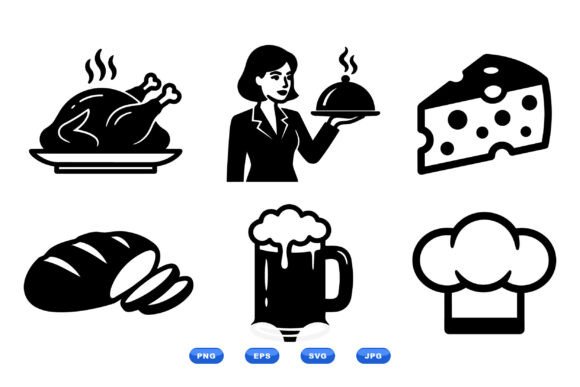
Opening the Classic Food Icon Clipart Set feels like stepping into a well-organized chef’s station—no clutter, no fuss, just six strong, intentional icons: roasted chicken, beer mug with foam, sliced bread, cheese wedge, chef hat, and a waitress holding a covered tray. All rendered in crisp black-and-white vector style, minimalist but never sterile. There’s warmth in the curves of the mug, quiet dignity in the chef hat’s brim, and just enough personality in the waitress’s posture to suggest service without caricature. This isn’t cartoonish clipart—it’s design with restraint, built for legibility at small scales and clarity under thread.
A Real Project Test: Embroidering a Boutique Kitchen Towel Set
Last week, I prepped a limited run of linen tea towels for a local café pop-up—each towel featured one icon from the Classic Food Icon Clipart Set, centered and sized to 3.2" wide. No text, no borders, just the icon in matte black thread on natural flax. The result? Instant cohesion. Customers paused mid-aisle—not because the designs screamed, but because they *settled*. That roasted chicken read clearly at arm’s length; the cheese wedge held its shape without filling in; the waitress’s tray stayed distinct, even with subtle satin stitch shading. It felt handmade, not mass-produced—exactly what small shop buyers respond to.
Where It Shines (and Where It Asks for Care)
The Classic Food Icon Clipart Set excels in projects where simplicity communicates authenticity: embroidered aprons for food trucks, baby bibs with the chef hat, sweatshirt chest logos for culinary schools, or iron-on patches for restaurant staff. Its clean lines translate beautifully to fill stitch and running stitch alike—no dense nesting or excessive jump stitches that gum up delicate fabrics.
That said, it’s not universally forgiving. On thin cotton tees or stretchy jersey, the fine outlines (like the foam detail on the beer mug or the crumb texture on the bread) may blur unless stabilized properly. On dark fabric, avoid ultra-thin line weights—test first with high-contrast thread. And while the waitress icon reads well on flat surfaces like tote bags or pillow covers, her tray edge and hat brim can lose definition on curved caps or tightly seamed baby hats unless resized thoughtfully.
Stitching Notes Every Designer Should Check
- Test on scrap fabric first—especially with textured linens or terry cloth kitchen towels, where stitch density affects how cleanly the cheese holes or bread crust hold up.
- Review stitch density: Minimalist doesn’t mean low-stitch—some icons use strategic satin stitch for dimension (e.g., the mug’s foam). Confirm your machine handles those transitions smoothly.
- Confirm hoop size compatibility: At full scale, these icons sit comfortably in a 4x4 hoop—but if you’re layering them (say, chicken + chef hat + “Est. 2023” on an apron), map spacing early.
- Inspect small details: The waitress’s fingers, the cheese rind texture, and the bread’s slice lines are subtle but intentional. If your embroidery file simplifies those in conversion, you’ll lose character.
- Try black-and-white mockups before committing thread colors—this set was made for monochrome impact, and seeing it against light vs. dark backgrounds reveals which icons pop strongest for your product.
- Use cutaway or tear-away stabilizer depending on fabric weight—lightweight cutaway worked best for the linen towels; medium tear-away kept the sweatshirt chest logo crisp without stiffness.
- Verify licensing before selling finished products or digital embroidery files. Since this is a Graphics asset intended for Crafts, confirm whether commercial use—including Etsy listings and boutique merchandise—is explicitly permitted.
How It Elevates Your Finished Product
Customers don’t buy icons—they buy feeling. The Classic Food Icon Clipart Set delivers immediate recognition (a beer mug = celebration, a chef hat = craft, a covered tray = hospitality) without over-explaining. That builds trust fast, especially for personalized gifts or holiday embroidery—think “Chef Dad” on a dad cap or “Brew Crew” on a couple’s matching sweatshirts. For Etsy sellers, it adds polish to listings: clean icons make printable mockups look pro, and consistent styling across a set (chicken, bread, cheese) strengthens brand storytelling for food-themed shops.
It also raises perceived value. A minimalist embroidered patch feels intentional, not generic. Buyers notice the difference between rushed clipart and considered design—and they pay more for it. In nursery decor or baby embroidery, the gentle shapes feel warm and ageless. On holiday gifts like embroidered oven mitts or aprons, it avoids seasonal clichés while still feeling festive and personal.
Final Thought: A Quiet Workhorse, Not a Flashy Gimmick
The Classic Food Icon Clipart Set won’t shout from a craft fair table—but it will earn repeat orders. It’s the kind of design that works as hard behind the scenes as it does on the front of a custom tote bag or the cuff of a chef’s jacket. It respects the craft: no unnecessary complexity, no visual noise, just six icons built to stitch cleanly, sell honestly, and represent real food culture with quiet confidence. If your craft business values clarity over clutter, and authenticity over animation, this set earns its place in your embroidery project toolkit.